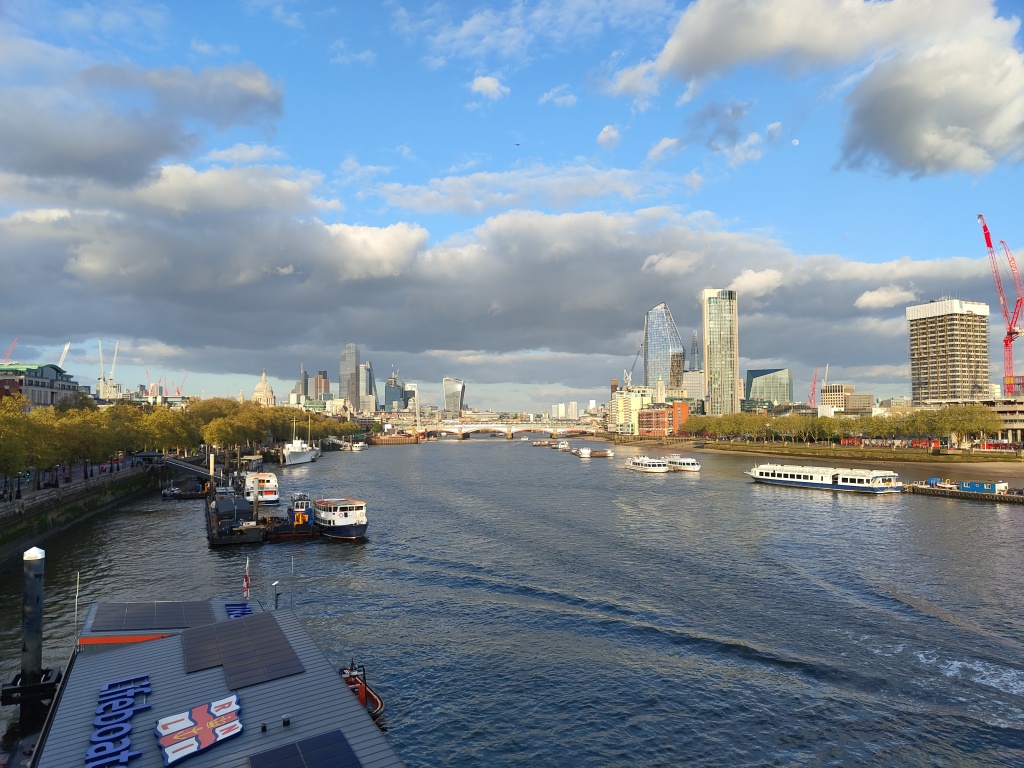
Standing outside the National Theatre on a warm spring evening, the Thames is inviting and refreshing, a mirror for sunlight and conduit for cool breeze in equal measure. Inside? Not so much, as the Lyttelton Theatre hosts a story that begins and ends with dead bodies floating in the river.
This is London Tide, an adaptation of Charles Dickens’ last novel, Our Mutual Friend. It appears to be the first theatrical treatment of the book, and for good reason – serialised monthly from 1864 to 1865, the complete book comes in at over 800 pages. Transforming it into three hours of theatre is no easy task, but Ben Power has made a solid go at it, making strong choices in what to pare down and rearrange to make a cohesive story. London Tide condenses around the arcs of two leading women – Lizzie Hexam (Ami Tredrea) and Bella Wilfer (Bella Maclean), and their relationships with family, suitors, and personal ambitions, especially their drive to escape poverty and the bounds of their social status. In many cases, Dickens’ original dialogue is preserved or closely approximated, lending the scenes genuine Victorian flavour. The story is engaging, clever, interesting, and it flows well – for the most part.
The show becomes weaker, however, in its attempts to wrap up the story too neatly. In particular, the first and last ten minutes of the show lean on narration and straight exposition that feels rushed and in some cases repetitive. And does the last scene of the first act need to be (spoilers!) a monologue from John Rokesmith (Tom Mothersdale) explaining his true identity as the presumed-dead John Harmon, and the circumstances that caused this to be? The hidden identity has been gradually developed in prior scenes; the circumstances will be reiterated in future ones. The primary school lesson on writing applies here: “Show, don’t tell.”
The script inconsistencies are frustrating here because, in most other respects, London Tide is very good. The acting is across-the-board excellent, from longtime stage presences such as Peter Wight (Noddy Boffin) to newer faces such as Ellie-May Sheridan (Jenny Wren), as well as the aforementioned female leads and their lovestruck counterparts (Mothersdale, and Jamael Westman as Eugene Wrayburn). Family bonds within the Wilfers and Hexams are played truthfully and beautifully, with a genuine love. Joe Armstrong (Roger Riderhood) and Scott Karim (Bradley Headstone) play complex, multi-dimensional antagonists. The production design, as well, is minimalistic but highly effective, leveraging rows of shifting lights and a pneumatic stage to mirror the undulating face of the River Thames upon which so much of the action – not to mention the thematic core – of the story takes place.
The Thames is a prominent motif in the novel, but as evidenced by the retitled production, it’s even more so here. The river ties every character together in some way or another. It’s a macabre source of livelihood for the Hexams; an agent of death, both accidental and intentional; and a place of baptism and resurrection for both Harmon and Wrayburn.
If that wasn’t clear enough from the story, production, and choreography… It’s helpfully repeated several times in the opening song: “This is a story…about Death/And Resurrection.” Yes, this is a musical, though you’d be forgiven for wondering “Why?” Not that the music is bad – it’s really not – but to some extent it feels like an afterthought, especially lyrically. This is compounded by the reality that the cast are splendid actors but not uniformly strong singers, taking on songs which are not particularly easy to sing – melodies sit heavily in the actors’ lower registers, never a great recipe for strong vocals. The choice to only have three musicians, all on-stage, also limits the sonic energy, with guitar-led orchestrations faring better than the ones led by keys and synth. Altogether, the songs help with pacing but are more about the narrative than integral to it – this could easily run as a straight play in a (hypothetical) future production.
As for its current form, London Tide may be rough around the edges, but it’s got a strong core. The performances, story, and production are already top-flight, and the National Theatre is the perfect place for the book and music to be trialled and refined over time. See it now (at the NT’s great prices), and your visit will be well worth it – but keep an eye out for what future productions do with the play.
Rating: 3.5/5
The Best Deal: £10 tickets from National Theatre’s Friday Rush.




 Twopenny Theatre
Leave a comment