Two productions of Shakespeare: one lasting barely over two hours, and the other lasting more than three and a half. Which one will leave you more exhausted?
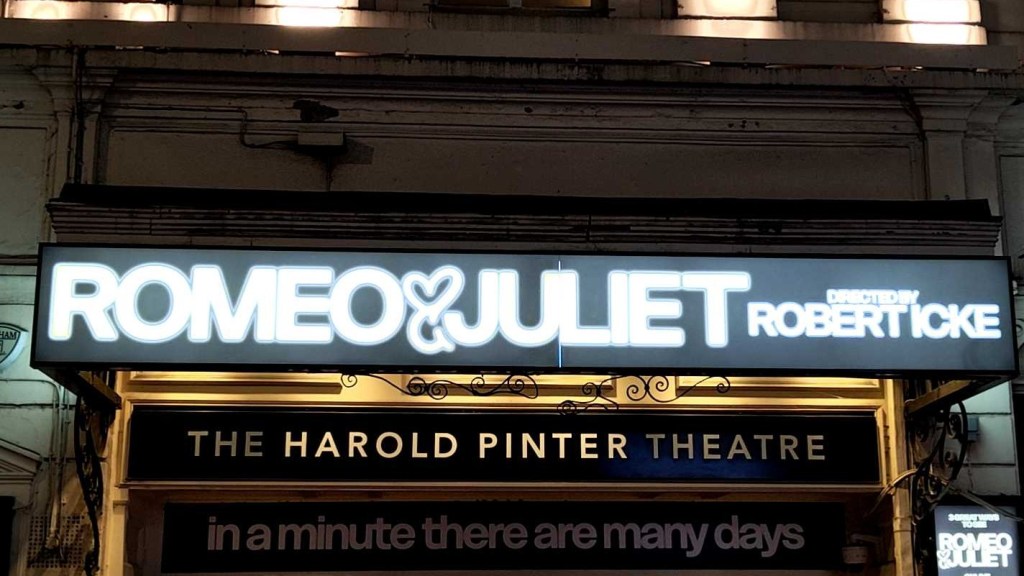
It’s the two-hour one, obviously, a new production of Romeo and Juliet from rising West End impresario Jamie Lloyd which is stripped down to its bare bones and then some. Gone are about an hour of dialogue, props, sets, extraneous blocking, and any colour that’s not black, white, or red. Actors’ expressions are subdued, leaving emotion conveyed solely by the delicate instruments of eyes and voice. And scene breaks are right out, so much so that if you arrive late or have to nip to the loo, you won’t be readmitted til the interval.
This Romeo and Juliet is as relentless as it is austere, marching – nay, hurtling – downhill to the untimely demise of the titular characters. Its pointedness is clear not only through the revised script’s structure, but also in its portrayal. From the opening scene, characters seem to know that they’re in a tragedy, carrying a melancholy countenance that isn’t fully shaken in even the happiest or most humorous scenes. Not that there are many of those – save for a few comedic moments between Juliet and her nurse (Freema Agyeman), and the requisite scenes of youthful tenderness between Romeo and Juliet, already-sparse moments of levity and hope from the original text are largely excised.
It’s a valid treatment of the play, given this is one of Shakespeare’s most famous tragedies, but it’s also pushed so far that the production starts to lose some of its thematic complexity. The Montague/Capulet family feud that undergirds the original story is less present here, and the pure brevity of the script means that character motivations have less time to fully develop. What you’re left with is just what it says on the tin: “The Tragedy of Romeo and Juliet.”
Of course, that’s all that many will care about for this production, which is running off the star power of Spider-Man sensation Tom Holland as the titular young suitor. In such a stripped down show, the actors have to prove worthy of your full attention, and thankfully he and fellow headliner Francesca Amewudah-Rivers fit the bill. Amewudah-Rivers has a tough job to do, co-starring with an actor whose name has single-handedly dragged the audience’s age at least a decade below the West End average and engendered a paparazzi presence outside the theatre, but her stage presence is a worthy match for Holland. In shared scenes, the two are magnetic, even if their movement is a little stiff.
Really, this whole production is a little stiff, to the point that it comes across as suffocating. It’s a welcome respite when the monochrome environment is broken up by live-filmed segments staged throughout the theatre. The full space of the Duke of York is used for these scenes – basement, roof, side alleys, even the foyer – which are refreshingly dynamic, adding colour and movement. Sooner or later, however, characters always return to an on-stage Verona where dense fog suffices for set and things feel more staid and sombre.
Ultimately, this is a polarising production, one where you can appreciate the aggressiveness of Lloyd’s choices and the effort of the players even if you don’t vibe with the overall effect. Perhaps that’s enough for a show like this, which judging by its still sold-out bookings is on-track to be a marquee event of the season. Come for the show – just don’t expect to get too comfortable.
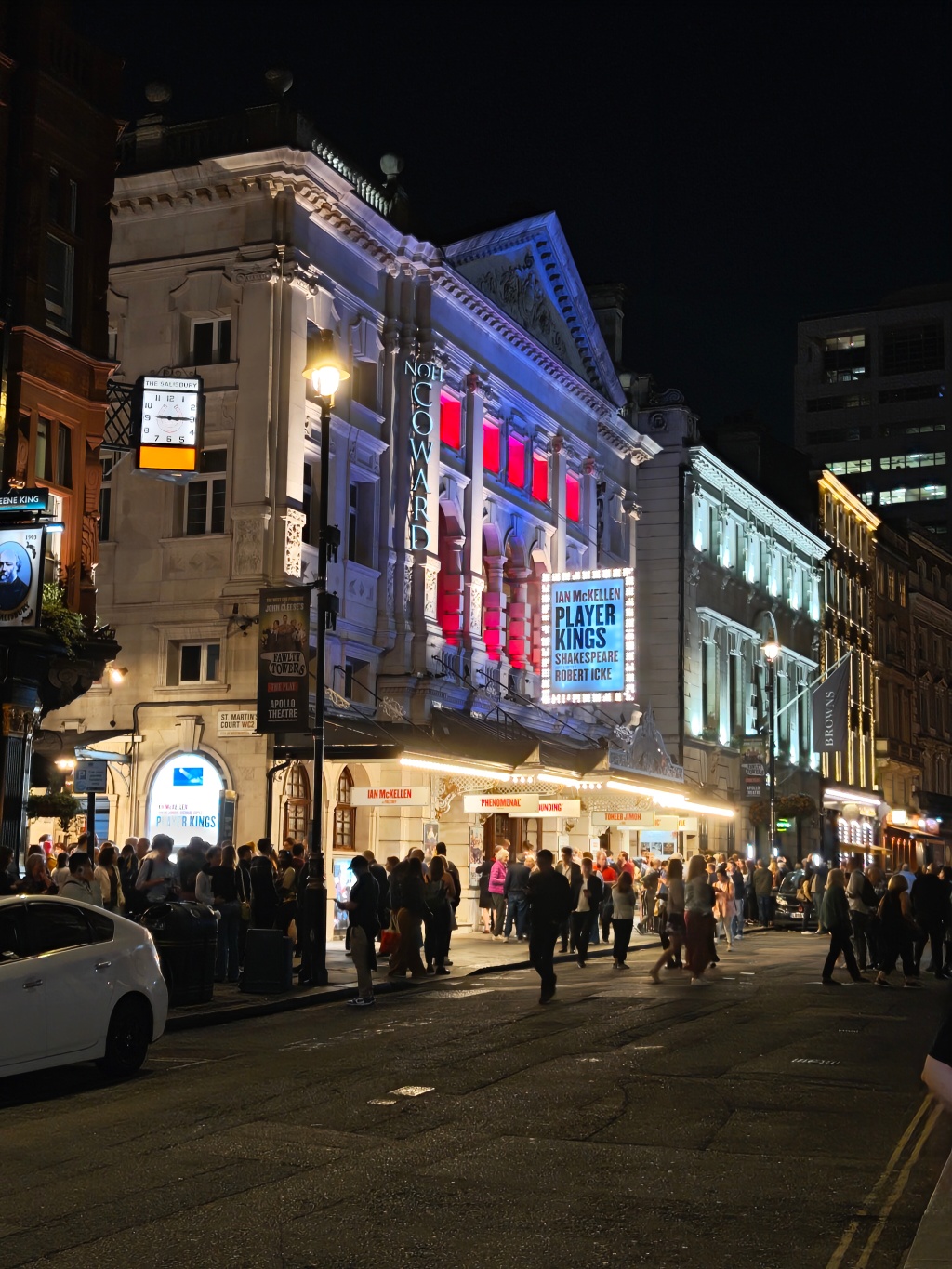
Which brings us to our other Shakespeare show starring an actor you’re likely to know from the movies. Just up St. Martin’s Lane from Romeo and Juliet – nary 100 metres, in fact – is Player Kings, an adaptation of both parts of Henry IV starring Ian McKellen.
At 85, McKellen’s (Lord of the Rings, X-Men) own star power attracts an audience a decade above the West End average, but there’s someone for everyone here, including a stoic Richard Coyle (Fantastic Beasts) as the eponymous Henry IV and Toheeb Jimoh (Ted Lasso) as a charmingly roguish Prince Hal. Together, the relationship between McKellen’s Falstaff and Jimoh’s Hal forms the backbone of this revised production, and the two make for lovely scene partners. One can’t help but see some real-world mentor/mentee energy behind the pairing, in a way that grounds their on-stage chemistry and Falstaff’s continual antics.
Playing a character that’s continually disparaged as lazy, foolish, and fat (no attempt is made to curb the body humour in Shakespeare’s original text, with Falstaff’s costuming lending him an aggressive beer gut), McKellen exhibits a learned ear for the Bard’s witticisms, delivering them with a deft gruffness that earns laughs aplenty. Forget King Henry – this is McKellen holding court, leveraging his nearly 60-year career playing Shakespeare to full effect. Combined with the charisma of Jimoh, Player Kings is elevated beyond what in other hands would be a pleasant but somewhat forgettable play.
Not much is ground-breaking about the production itself – shows which combine the two parts of Henry IV are nothing new, as are modern trimmings around Shakespearean classics. There are some tasteful visuals that connect history with the present: Henry IV and his advisors in suits around a conference call in Westminster, for instance, or the King and his sons surveying the battlefield at Shrewsbury while costumed in camo fatigues and red berets. On the whole, however, this is a fairly classic treatment, one that feels comfortable in its own skin and doesn’t try to be too flashy. In isolation, this wouldn’t be notable, but viewed back-to-back after the visual desert of Romeo and Juliet, the difference is night and day. Props, sets, costumes, colour – these simple pleasures of the theatre can’t be taken for granted.
The big ask from Player Kings is the runtime: at 3 hours and 40 minutes (including the interval), you’ll be thankful that the seats at the Noël Coward Theatre are passably plush. This is also a front-loaded show, with the first half having more action and more laughs. The question is – what would you cut? What could you cut? Player Kings has appropriately centred the story on Hal and Falstaff, and while the carousing of the first half is enjoyable in its own right, the more methodical second half makes it a fuller story, showing how Prince Hal comes into his own as a wisened and worthy heir to the throne. The play has kept the scenes that count in service of this narrative arc, and the result is a well-rounded show.
The one thing Player Kings and Romeo and Juliet have in common is a goal to make modern theatre out of Shakespeare’s ageless words. The former succeeds in producing a crowd pleasing show; the latter’s efforts seem intent on creating a theatrical event. Each has enough to recommend – so which to see depends largely on whether you’d rather be at the edge of your seat or relaxing back into it. As the Friar might say to Juliet: pick your poison!
Romeo and Juliet
Rating: 3/5
The Best Deal: £25 standing rush tickets, released Wednesdays
Player Kings
Rating: 4/5
The Best Deal: £30 daily rush tickets




 Twopenny Theatre
Leave a comment