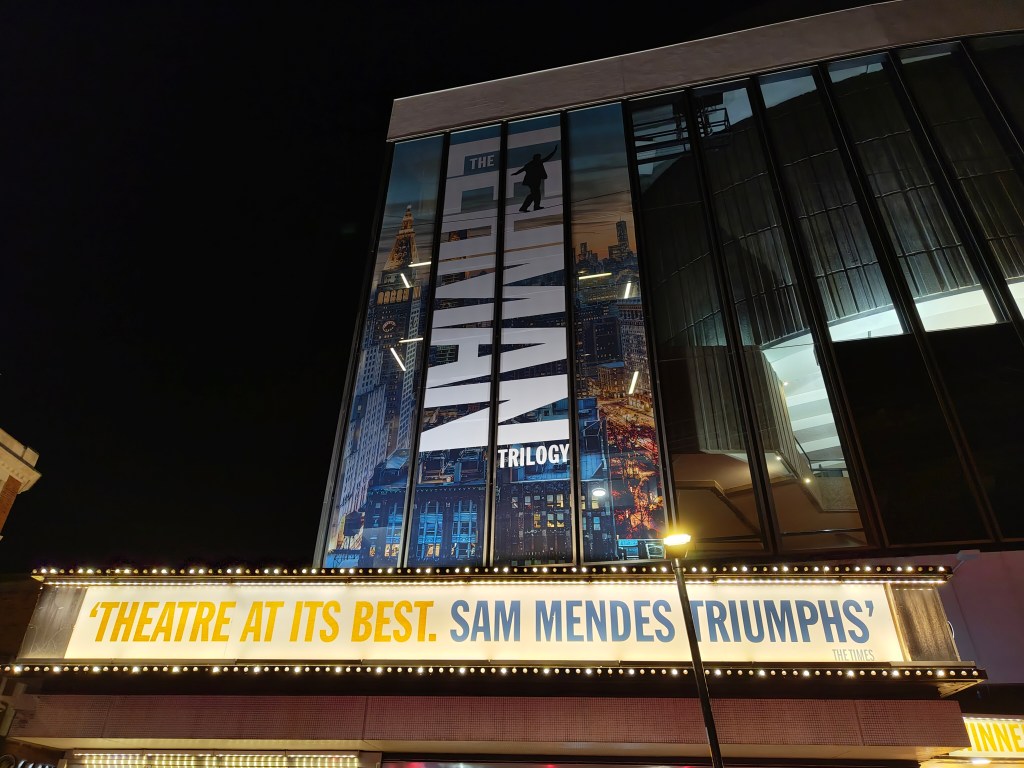
If you were designing a play for maximum commercial appeal, “Three hours of banking history” would not be the snappiest logline. But the lasting success of The Lehman Trilogy – now in its fourth London run since 2018 – is a good hint that this production is anything but academic. Instead, it’s a compelling, layered story, one that’s aiming to find some deeper truths beyond the mere facts of the past.
The play starts where the name “Lehman” became infamous – the 2008 collapse of the eponymous Lehman Brothers Corporation at the height of the global financial crisis. But The Lehman Trilogy isn’t so concerned with the aftermath of this event, focusing instead on the 150 years of Lehman Brothers that preceded it. In the beginning, there are no “brothers,” just one Heyum (later changed to Henry) Lehman (John Heffernan), who immigrates from Bavaria to America and sets up a small textile shop in Alabama. In short order, Henry is joined by brothers Emanuel (Howard W. Overshown) and Mayer (Aaron Krohn), the trio forming an unlikely outpost of Bavarian Judaism in the United States’ Deep South.
One theme of The Lehman Trilogy is Lehman’s investment in increasingly abstract markets, mirroring a broader trend in the American economy. The brothers’ business starts moving away from its retail origins after accepting next year’s cotton as store credit when several plantations are destroyed by fire. This morphs into a booming business as cotton wholesalers, with the brothers acting as an intermediary between Alabama plantations and northern textile mills. The word they apply to themselves – “middle-men” – meets laughter when one of the brothers goes to advertise their services to a plantation owner. Making money by selling someone else’s cotton? How strange! But that’s nothing compared to Lehman’s later days as a trading firm – selling shares in whatever people will buy.
Another theme is the moral ambivalence that comes with chasing profit. The brothers’ adopted hometown comes with an inconvenient truth that the play doesn’t outright ignore, but does leave somewhat unprobed. In Montgomery, Alabama, many of their best customers are plantation owners – enslavers (completely unmentioned are the brothers’ own slaves). Later, after the business moves to New York, its essence is neatly distilled by Emmanuel’s son Philip. In an interview with a Wall Street reporter, he tells him the “key ingredient” in the recipe of the bank is not “coal or coffee or cotton, but money itself.” In other words, it doesn’t matter as much how they make money, just that they do.
The Lehman Trilogy does a deft job at demonstrating how these are two sides of the same coin. The commodification of everything brings endless opportunities for profit, and hides the societal impacts behind ever-deeper layers of financial magic – until a shaky foundation becomes too big to ignore. The scope of Lehman manages to capture the two biggest instances of this in history: the “Black Thursday” crash preceding the Great Depression, and Lehman’s own bankruptcy prior to the Great Recession.
This is a play dealing in Big Ideas, but that doesn’t mean it’s not a good show. Six years on from its premiere at the National Theatre, the production is still sleek as anything, and one of the most impressive designs I’ve seen. The set (Es Delvin) takes a modern office floor and manages to embody a sort of temple to Finance, its glass walls gradually being covered by scrawling iterations of the Lehman Brothers sign and various figures – prices, deaths, sales. With an expansive video backdrop (Luke Halls), the whole thing carries a cinematic flair, perhaps unsurprising given Sam Mendes’ (American Beauty, 1917) direction. The cherry on top is Nick Powell’s score, played by pianist Cat Beveridge, whose beautiful performance adds a touch of elegance and humanity.
That’s helpful, because The Lehman Trilogy struggles at times to bring its century-spanning story down to a human scale. Despite some tactical rearranging of the historical record, characters rarely stay longer than an act, and sometimes just for a few scenes. Heffernan, Overshown, and Khron dutifully switch between accents and characterizations to play an ever-expanding web of Lehman descendants, business partners, and spouses, but sheer numbers mean it’s still sometimes hard to keep track of who’s who, and why we should care. This is especially egregious in the third act, where the trading-obsessed leaders of Lehman Brothers in its twilight years are sketched out in the broadest of terms, a consequence of the firm’s last 50 years being sped through in roughly 30 minutes. Even when we do get extended time with a Lehman, such as Philip or his son Robert, it’s hard to know what to make of them. Too mercenary to be heroes, too tactful to be villains – the best word to describe them might be “corporate.”
Nevertheless, The Lehman Trilogy is a surprisingly easy watch, in part because its roughly year-per-minute pace gives it an engaging sense of momentum. It’s also funnier than it has any right to be, with running gags (such as having to make a new sign every time the business changes) acting as a counterweight to its moments of more hard-nosed drama. Lehman is a show worth seeing – and at a meta level, it’s an especially interesting show to see in London. Here the emptied husk of Lehman Brothers International remains in administration some sixteen years after its insolvency, while myriad trading firms continue its quest to squeeze out profit wherever possible. If it’s true that those who don’t learn history are doomed to repeat it, perhaps that’s reason enough for many Londoners to see this play.
Rating: ★★★★
The Best Deal: £30 tickets released Fridays at 12 PM from LW Theatres, or daily at 10 AM on the TodayTix app


 Twopenny Theatre
Leave a comment