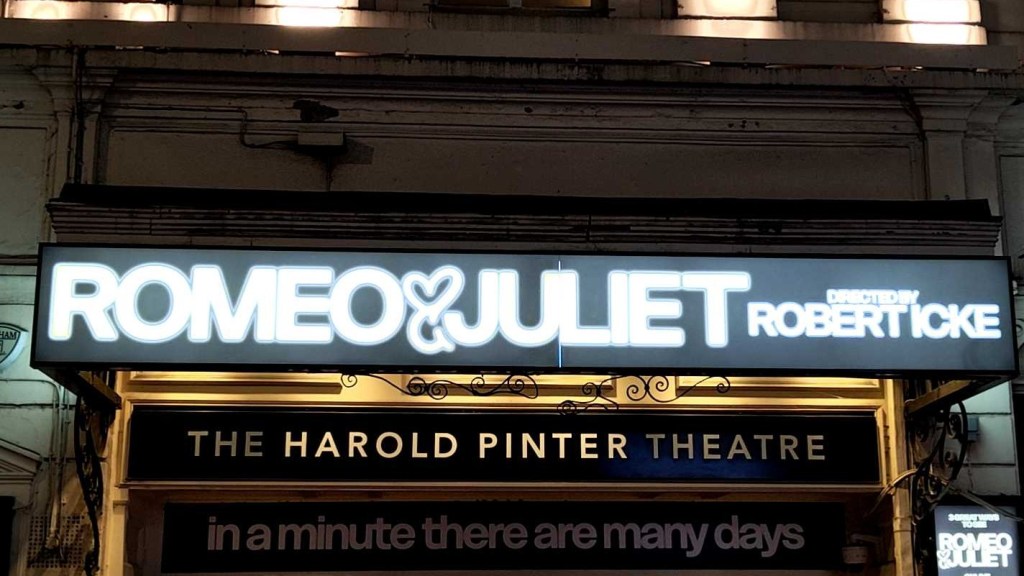
Do you remember your first hard crush? The one you couldn’t stop daydreaming about, spinning up fantasies about the future you’d have together – marriage, kids, home, growing old? If you can, you’ll be well positioned to appreciate Robert Icke’s new offering of Romeo and Juliet, which invites you to empathise with two children who famously find out that “violent delights have violent ends.”
Make no mistake, this Romeo and Juliet is still a tragedy. As Icke indulges the sense of romantic possibility between the young lovers, it has the effect of deepening the pit in your stomach that comes from their untimely demise. Yet, in its way, this is quite a kind production, which gives depth and sincerity to Romeo and Juliet’s motivations.
Credit for this is due to Icke’s direction but also the captivating performances of Noah Jupe and Sadie Sink in the title roles. By this point, Sink has plenty of experience playing “teens with a lot going on”, and it shows. By turns her Juliet is an epitome of teenage angst, a bundle of head-over-heals frenetic energy, a doting bride, and a disassociating daughter. Jupe has slightly less to do but matches up well. His Romeo is “one of the lads” but also a tender poet, a triumphant suitor, and a scared boy-turned fugitive.
Together, they’re electric. Their “balcony scene,” brought into Juliet’s bedroom, puts them face to face with both each other and the exhilarating, terrifying prospect of revealing just how much they’ve fallen for one another. Appropriately bashful after Romeo overhears her pining, Juliet processes by pacing, never quite able to break away from his magnetism. Meanwhile, confronted by Juliet’s probes for his intentions, Romeo psychs himself up to “go all in” and make an offer of marriage. What one takes away from the scene is not their naivety but their willingness to commit, to their credit. If you somehow came into this production without any pre-formed knowledge of the text, you’d be forgiven for thinking that this deepest of tragedies is more of a rom-com.
Like most productions of Romeo and Juliet these days, the group of supporting roles is condensed from the original; this gives room for several of them to be particularly well-characterized. Juliet’s long-suffering nurse and confidant (Clare Perkins) is wise-cracking and doting to a point – but clear-eyed to the danger of refusing to submit to the powers-that-be. Juliet’s dad, Signore Capulet (Clark Gregg) is such a power – at times magnanimous, but only insofar as it reinforces his desire for control. As this slips through his fingers, he grasps at it ever more tightly. His insistence that Juliet will marry her cousin Paris, at the threat of her disownment, is the moment where you can see her will to live evaporate (Sink plays this moment particularly well). Unknowingly, he consigns her to adultery while standing metres from the bed where Romeo and Juliet have just shared their wedding night.
The crowd favourite, at least for the younger audience (and yes, the audience does skew quite young) is almost certainly Mercutio (Kasper Hilton-Hille). He’s hilarious – delightfully juvenile and pestering, with his face-off with the Capulet nephew Tybalt as his tour-de-force. Shakespeare’s text has him calling Tybalt the “Good king of cats”. To this, Icke also has him “meow”ing at and mooning him. When stabbed, in spite of Romeo’s attempts at deescalation, most of his dying monologue is delivered with the same arch energy – only moments before his exit does his face flush with terror when he realizes he’s actually received a “mortal wound.”
That keen sense of the thin line between comedy and tragedy is what makes this production powerful. There’s another world where Romeo and Juliet could have lived that first-crush fantasy and buried their families’ blood feud – or at least had more than just a night of marital bliss. We see glimpses of it via a sprinkling of scenes which start twice before diverging, a simple dissection of the butterfly effect.
For most of the show’s second half, we see Romeo and Juliet trying to claw their way back to that world. Their escalating subterfuge and poison procurement reeks of desperation, but their noble motivation is clear. They just want to be together – is that too much to ask? The Fates (and the text) say “yes.”
Could you do a more audacious take on Romeo and Juliet? Probably – but that’s certainly no guarantee of success. Here, Icke has managed to take a story full of absurd choices, massive tonal shifts, and the cruel invention of Fate, and make it all flow. The great cast helps, as do the little things – tight sound cues (Giles Thomas), and a minimal set (Hildegard Bechtler) that still leaves room for surprises. This is Shakespeare presented clearly and poignantly – a tragedy that’s a joy to watch.
Rating: ★★★★★
The best deal: Pay-what-you can rush tickets, released Wednesdays. Sign up on the show website.




 Twopenny Theatre
Leave a comment